%20(1)_edited.png)
The Throughline: How Mary Fuller Built a Career Around Access, One Unlikely Step at a Time
ADAPT Industry Spotlight
When Mary Fuller describes her career, she reaches for an analogy rooted in her earliest professional training: she was learning to troubleshoot life the same way she troubleshot circuits. "You figure out what's broken, fix what you can, keep building," she said. It's a deceptively simple framework for a path that has taken her from a single-wide trailer in Arizona to the federal government, and from there to the deanship of one of California's most storied law schools.
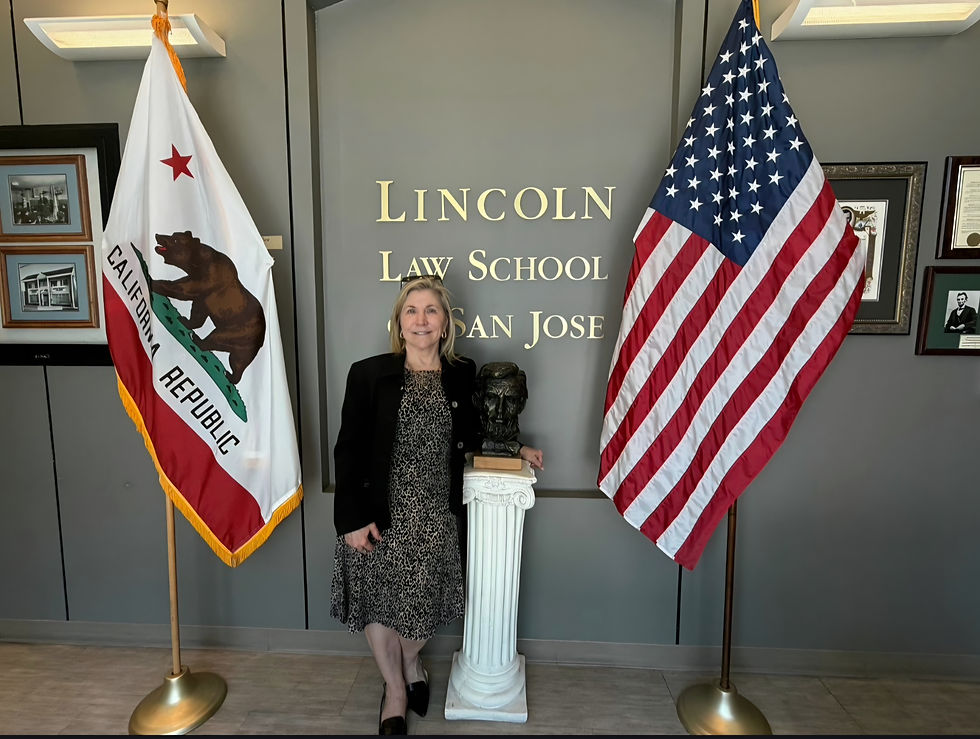
Fuller is the Dean of Lincoln Law School in San Jose, a position she stepped into after serving as Director of the USPTO's Western Regional Office. Before that, she was a patent litigator, an in-house attorney, a federal executive, and, even earlier, an electrical engineer who tested autopilots for private jets. She’s the first to tell you that none of it was planned.
"When people look at my resume, they see this nonlinear career," she said. "Engineer, patent attorney, litigation director, government executive, and now dean. But as I was going through it, it didn't feel nonlinear while I was living it. It felt like responding to what was in front of me."
School as the One Constant
Fuller grew up in the Greater Phoenix area in a household that moved frequently due to financial instability. By the time she was ten, she had learned to hold lightly to friendships and geography. What she clung to instead was school. In classrooms that changed every year or two, academic performance was the one thing she could control, and she controlled it deliberately, becoming one of the strongest students in every new class she entered.
That orientation toward learning as a form of stability carried her into a vocational electronics program in high school, where a skeptical instructor made clear from day one that freshmen were not welcome and girls were even less so. Rather than being discouraged, Fuller found herself ignited. She fought to stay, fought to prove she belonged, and later reflected that without his resistance, she might never have become an electronics technician, an electrical engineer, or a patent attorney.
For six years after high school, she worked full-time during the day and attended Glendale Community College at night, eventually earning an associate's degree in electronic technology. She was proud of her single-wide trailer, responsible for the lot rent and the payments, cutting back on food when Sperry Avionics, her employer at the time, started struggling. The math she was doing in her head then was survival math: what has to be paid, what can be turned off, how long can this stretch? What she held onto, through all of it, was school.
The Accidental Discovery of IP
At 23, Fuller left her technician role, enrolled at Northern Arizona University, and earned an electrical engineering degree in three years, a timeline made possible by all those years of night school. After earning her degree, she packed her car, pointed it north, and arrived in Boise, Idaho, to work as an engineer at Hewlett-Packard.
HP encouraged its engineers to spend up to twenty percent of their time exploring new areas, and Fuller took that invitation seriously. She designed a circuit adapter that other divisions found useful, which led to six international supplier evaluation trips and, in the process, introductions to six different patent attorneys. She was curious about their work, so she asked each of them about their careers.
Every one of them said they would choose the same career all over again. What they loved, above all else, was that it never became repetitive. For Fuller, who was already feeling the tedium of designing the same power supply with minor variations, that answer landed hard. She realized she loved learning more than repeating, and that insight was what led her to law school.
She chose Notre Dame for reasons she describes with characteristic candor. She had watched the film Rudy, felt something in it, and was drawn to a school that promised tradition and belonging rather than prestige. "Growing up moving more frequently, I built competence, I was smart. But belonging felt different, and Notre Dame felt like something that would be enduring."
What she encountered in law school, and in the career that followed, sharpened her thinking on something important: she had only found intellectual property because she happened to be in the right rooms at the right time. The discovery had been accidental, and she knew it.
Mentorship That Actually Moves People Through Doors
After graduating from Notre Dame, Fuller faced a choice between returning in-house to HP, where she had interned and where she felt professionally at home, or joining Pennie Edmonds, then the oldest and largest patent boutique in the world. Her mentor at HP, Bill McAllister, pushed her toward the law firm. She didn’t take it well at first.
"My feelings were really hurt. I remember thinking, why don't they want me back? What's wrong with me?" She laughs telling the story now. McAllister was not pushing her out; he was advocating for her growth, knowing that the volume and variety of work at Pennie would accelerate her career in ways that staying in-house never could. He was right. That push was pivotal.
The experience sharpened a distinction she now holds firmly between mentorship and sponsorship. A mentor shares their story, offers guidance, and can be enormously helpful. But sponsorship is different. A sponsor uses their credibility on your behalf. They put your name forward when you are not in the room. They do not just point at the door and say, that is the door I walked through, you should walk through it too. They pull you through it.
"In my own career, the most pivotal moments were not when someone encouraged me. They were when someone advocated for me. Mentorship feels supportive. Sponsorship changes trajectory."
She also draws a line between what she calls aspirational and actionable support. A program that pairs people together and calls it development is not the same as one that transfers real skills, creates proximity, and opens actual opportunities. Pairing, she says, is not always development.
Access as a System Problem, Not a Personal One
When asked what meaningful access to IP education actually looks like in practice, Fuller does not hedge. It looks like students in community colleges, engineering programs, and vocational settings being introduced to the idea that protecting ideas is itself a career path, and that their technical or creative skills can translate into that work. It looks like innovators understanding clearly that their ideas have value and can be protected before someone else explains it to them by accident on a business trip.
"IP is powerful because it sits at the intersection of creativity and commerce," she said. "But if only people with proximity or privilege know about it, then that system narrows itself. Expanding access, not lowering standards, is the way to go. It widens awareness."
This is the lens through which she now sees her role at Lincoln Law School, which was founded in 1919 by Dr. Benjamin Fraklin Lickey and his wife, Susan. They founded the school specifically for working people and non-traditional students. It has always been an evening school. When Fuller looks at her students today, she sees people balancing jobs, families, bills, and exhaustion alongside their legal education. She has been that person, she knows the quiet math of wondering whether slow progress is actually progress at all.
"I understand what it's like to go to six years of night school inside an unpredictable life. I understand being proud of small victories, like a single-wide trailer on a double-wide lot. I understand that quiet math in your head, wondering if you can afford all this and do everything. I know this is a struggle. I see it on our students' faces all the time."
The Throughline
Ask Fuller what connects a career that has moved from electronics technician to engineer to patent litigator to federal director to law school dean, and she answers without hesitation: dignity. Dignity in work, dignity in steady progress even when no one is applauding it, dignity in showing up for yourself when the path ahead is uncertain. And most of all, the dignity of showing up for others and helping them make room for their own progress, their own experiences, and their own journey.
"Stability wasn't staying in one place. It was building skills and character that traveled with me. They traveled from a trailer, to night school classrooms, to a factory floor, to law firms, to boardrooms."
For anyone currently in the middle of that kind of journey, still doing that quiet math in their head and wondering whether the slow progress counts, she offers this: it does. Nothing learned is ever wasted, even when you cannot yet see where it is leading. The pattern becomes visible later. The throughline reveals itself in retrospect.

That is what ADAPT is working to change: making the pattern visible earlier, so that the people who most need it do not have to wait until they look back to see it.
A warm thank you to Ashley Cheung of Virtual Patent Gateway, who thoughtfully made the introduction and shared the episode.
Sarah Foley
Founder, Foley IP Law, PLLC
ADAPT Communications Team


Comments